Last Updated on May 2, 2026 by Kravelv Spiegel
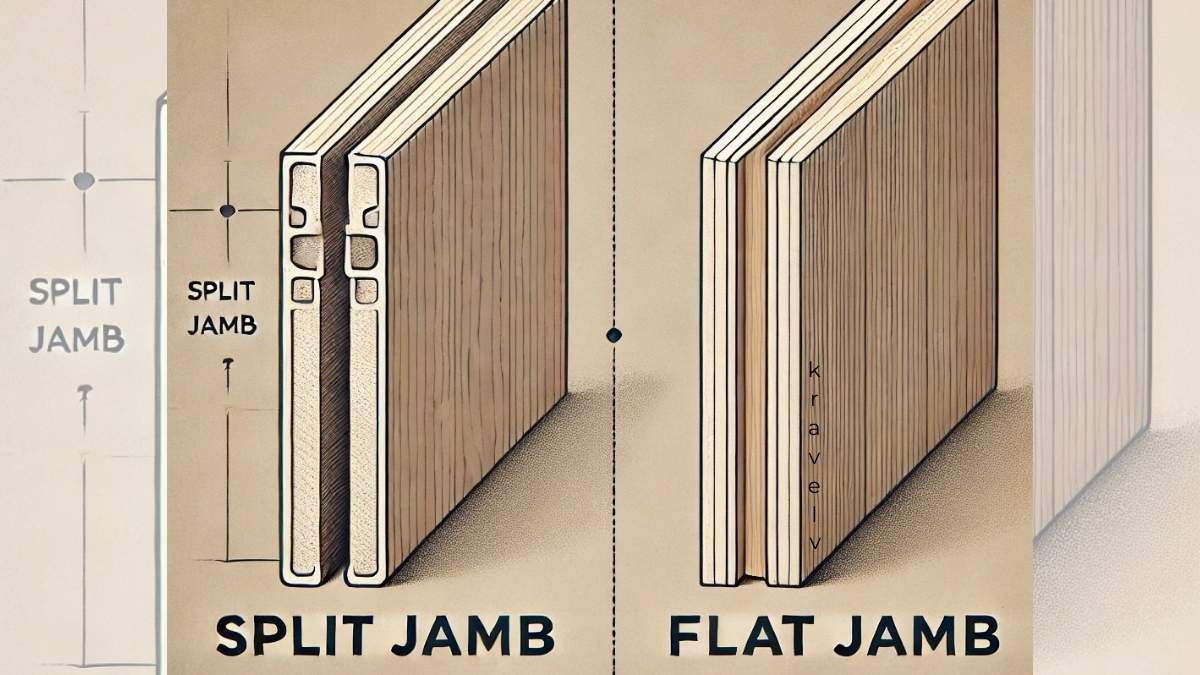
Split jambs consist of two pieces and are ideal for uneven walls, while flat jambs are solid and better suited for new construction. A split jamb is a two-piece door frame system where each half clamps onto opposite sides of the wall, making it ideal for pre-hung door installations, renovations, and walls with non-standard or inconsistent thickness.
A flat jamb is a single-piece frame without a built-in stop, requiring a separately installed door stop and additional trim work, and is best suited for new construction with standard wall dimensions. The right choice depends on three factors: wall thickness consistency, whether the door is pre-hung or slab-only, and whether you want an integrated casing finish or prefer to add trim separately. Neither type is universally better. Both are widely used in residential construction for different reasons.
Split Jamb vs Flat Jamb: Side-by-Side Comparison
| Feature | Split Jamb | Flat Jamb |
|---|---|---|
| Construction | Two-piece system | Single-piece |
| Frame thickness | Approximately 1-1/16 inch | 11/16 inch (standard) or 1-1/16 inch (5/4 version) |
| Standard jamb widths | 4-9/16 inch and 6-9/16 inch | 4-9/16 inch and 6-9/16 inch |
| Wall thickness adaptability | Adjustable | Fixed to cut dimension |
| Built-in door stop | Yes (on hinge half) | No (added separately) |
| Integrated casing option | Yes (often included with pre-hung unit) | No (added separately) |
| Best application | Pre-hung doors, renovations | New construction, slab doors |
| Structural rigidity | Moderate (two-piece) | Higher (single piece) |
| Installation complexity | Moderate (alignment between two halves) | Lower for standard walls |
| Material cost | Higher | Lower |
| Labor cost | Lower for pre-hung installs | Higher for slab door installs |
| Caseless installation | No | Yes (kerfed variant) |
What Is a Door Jamb?
A door jamb is the vertical structural member on each side of a door opening that holds the door in place, supports the hinges, and provides a surface for the strike plate and latch hardware. Together with the head jamb (the horizontal top piece), the two side jambs form the door frame.
The door jamb is the vertical portion of the frame onto which a door is secured, and the strip of wood where the hinges are attached. It provides support and structure to the door, ensuring it hangs correctly and opens and closes smoothly. Without a properly installed jamb, the door cannot maintain alignment, close cleanly, or operate securely.
The width of the door jamb is equal to the wall thickness of the doorway. This is the most critical measurement in jamb selection. Most homes are built with either 2×4 or 2×6 studs. For 2×4 construction, a 4-9/16 inch jamb is most common, while 2×6 construction typically uses a 6-9/16 inch jamb. These sizes account for the studs plus drywall and other wall finishes, allowing the door frame to sit flush with the wall on both sides.
If the jamb is too shallow, the rough framing is exposed between the edge of the jamb and the wall surface. If it is too deep, the jamb protrudes past the wall and requires trimming or additional shimming. Getting this measurement right before choosing between split and flat is the foundation of a successful installation.
What Is a Split Jamb?
Split jambs are a two-piece system. The frame is pre-hung together but can be taken apart for easy installation. One half contains the door stop and hinge side, while the second half slots into a groove or clips onto the back of the first half from the opposite side of the wall. The two pieces interlock to clamp the wall between them.
A split jamb, making it highly versatile for varying wall thicknesses, has a frame thickness of approximately 1-1/16 inch (approximately 1.06 inches). This slim profile, combined with the two-piece adjustability, allows it to accommodate walls that are not precisely at a standard dimension.
Split jambs are the standard system used with pre-hung door units, where the door slab comes already mounted on the hinges within the frame. The pre-hung assembly is inserted into the rough opening, one half is secured from the interior side, and the second half is pressed onto the exterior side and interlocked. Shims behind the hinge and latch locations level and plumb the unit before final fastening.
The casing (decorative trim) is often integrated into a split jamb unit or supplied as part of the pre-hung package, providing a finished appearance on both sides of the wall without requiring separate trim installation.
When Is a Split Jamb the Right Choice?
Renovations and retrofits in older homes. Older homes, remodels, or plaster walls can change wall thickness, which is why measuring the existing jamb is more reliable than assuming a standard size. In these situations, a split jamb’s ability to straddle non-standard wall depths makes it the practical default.
Pre-hung door installations. Split jambs are the dominant system used with pre-hung door units across residential construction. The two-piece design simplifies inserting the pre-hung assembly into the rough opening and adjusting from both sides simultaneously.
Walls with inconsistent thickness. Where wall framing has settled, drywall thickness varies, or multiple finish layers have accumulated over years of renovation, a flat jamb cut to a precise single dimension may not sit flush on both faces. A split jamb absorbs these inconsistencies.
Faster installation on large projects. Split jambs simplify the installation process, especially when working with pre-hung doors, and offer easy adjustability for uneven walls or non-standard door openings.
| Advantages of Split Jambs | Disadvantages of Split Jambs |
|---|---|
| ✅Adjustable to accommodate walls of varying or non-standard thickness ✅Integrated with most pre-hung door units, streamlining installation ✅Built-in casing option provides a finished look on both faces without separate trim ✅Preferred choice for renovation and remodeling projects ✅Accessible from both sides of the wall during installation, improving plumb and level accuracy | ❌Two-piece assembly requires careful alignment during installation to prevent the halves from misregistering ❌Generally higher cost than flat jambs ❌Less structurally rigid than a single-piece flat jamb of equivalent depth ❌Limited supplier base in some regions compared to standard flat jamb stock |
What Is a Flat Jamb?
A flat jamb is a type of door frame with a straight, flat profile that does not have any rabbet or recessed edge. The door panel sits flush with the frame, creating a clean and minimalistic appearance. With a flat jamb, the door stop needs to be added separately.
The flat jamb is typically 11/16 inch (approximately 0.6875 inches) thick for the standard version, providing a clean and minimal frame for interior doors. A heavier 5/4 flat jamb measuring 1-1/16 inches thick is also available for applications requiring greater rigidity. It is a single milled piece of wood or engineered lumber that spans the full wall thickness. Door jambs must match the full wall thickness, accounting for both the stud and sheetrock. Most walls are framed with either 2×4 or 2×6 studs and finished with 1/2 inch or 5/8 inch sheetrock.
Because a flat jamb has no integrated stop, a separate wood stop is nailed to the face of the jamb after the door is hung. The stop prevents the door from swinging through the opening when it closes and provides the surface against which the door seals. Casing is also applied separately on both faces of the wall to cover the gap between the jamb edge and the wall surface.
Sun Mountain offers solid wood flat jambs with an adjustable stop. If the door is ordered with a factory-applied wood finish, the jambs and stop are finished separately, allowing for easy on-site adjustment without the need for finish touch-ups.
Flat jambs are also available in kerfed versions. A kerf is a slot cut on the edge of the jamb, used for wrapping the drywall corner bead (square or rounded drywall corners), creating a clean caseless opening where the drywall meets the door frame directly, eliminating the need for case mouldings.
When Is a Flat Jamb the Right Choice?
New construction with standard wall dimensions. When walls are framed with consistent 2×4 or 2×6 studs and finished with standard drywall, flat jambs cut to the correct width sit flush without adjustment. This is the most cost-efficient scenario for flat jamb use.
Custom door installations with slab doors. When hanging a slab door (door only, no pre-attached frame), a flat jamb allows the installer to precisely set hinge locations and stop placement on-site rather than working within a pre-configured system.
Minimalist or caseless aesthetics. Kerfed flat jambs eliminate visible trim entirely by receiving the drywall edge directly into the kerf, creating a seamless transition from wall to door frame. This contemporary finish is not achievable with split jambs.
Budget-conscious projects in utility spaces. Flat jambs are great for temporary or utilitarian applications, such as in storage rooms, utility rooms, or garages.
| Advantages of Flat Jambs | Disadvantages of Flat Jambs |
|---|---|
| ✅Single-piece construction is more structurally rigid than a two-piece split system ✅Lower material cost, especially for new construction projects with standard wall dimensions ✅Easier to repaint, refinish, or replace a damaged section independently ✅Kerfed variants allow caseless installation for contemporary aesthetics ✅Widely available from lumber yards and door suppliers in standard widths | ❌Not suitable for walls with non-standard or inconsistent thickness without custom cutting or jamb extensions ❌Requires separate door stop installation ❌Requires separate casing trim on both faces for a finished appearance ❌More labor-intensive installation when working with slab doors versus pre-hung units |
How to Measure for the Right Jamb
Correct jamb selection starts with a precise wall thickness measurement. Jamb width is the measurement of the wall thickness that the door unit will be fitting into, including any sheetrock or sheathing or siding that is on the outside as well. If your jamb is too small, the framing or rough opening in the wall may be exposed, and if your jamb is too large then it will need to be trimmed and fitted to the wall.
To measure accurately: open the door and place a tape measure against the front face of the existing jamb (where the door closes). Extend the tape to the wall surface on the opposite side. Do not include the trim or casing thickness in the measurement. The result is your required jamb width.
For most projects, that means specifying 4-9/16 inch jambs for 2×4 interior partitions and 6-9/16 inch jambs for 2×6 exterior walls, adding custom or intermediate widths only where the wall assembly calls for it.
If your measured wall thickness falls significantly between standard sizes, a split jamb is the more practical solution. If it falls within the 1/16 inch tolerance band around a standard dimension, a flat jamb cut to that standard size will work cleanly.
Installation Overview
Installing a Split Jamb
- Measure the rough opening height and width. Confirm the wall thickness matches the jamb width specification.
- Separate the two halves of the split jamb unit.
- Insert the primary half (containing the door and hinges) into the rough opening from the interior side. Use shims behind the hinge locations and latch side to bring the unit plumb and level.
- Nail through the hinge jamb into the trimmer studs at the shim locations. Check plumb and square before final fastening.
- Press the second half of the split jamb onto the back side of the wall from the exterior side. The tongue-and-groove or kerf connection between the two halves locks them together.
- Nail or staple the second half through the casing into the wall. Check that both halves are flush with the wall surface on each side.
- Set the door stop if not pre-integrated. Test the door for proper swing, latch engagement, and even reveal around the perimeter.
Installing a Flat Jamb
- Measure wall thickness and select or cut a flat jamb to the correct width.
- Position the jamb in the rough opening. Insert shims behind the hinge locations, latch side, and head jamb to bring the unit plumb and square.
- Nail through the jamb into the trimmer studs at each shim location. Do not over-drive nails or the jamb will bow inward and bind the door.
- Hang the door on the hinges. Check for even reveal (gap between door edge and jamb) on all sides.
- Install the door stop by nailing it to the face of the jamb flush with the door face when the door is in the closed position.
- Apply casing trim to both faces of the wall. Miter corners at 45 degrees and nail into both the jamb edge and the wall framing.
- Fill nail holes, sand, prime, and paint or finish as required.
Common Installation Mistakes to Avoid
Not measuring wall thickness before ordering. Ordering a jamb at the assumed standard size without measuring is the most common source of installation problems. Walls in homes older than 30 years frequently have non-standard thickness from plaster, multiple drywall layers, or added insulation.
Skipping shims on flat jambs. A flat jamb nailed directly to rough framing without shims will follow every imperfection in the framing, creating a bowed jamb that binds the door. Shim at every hinge location and the latch side at a minimum.
Misaligning split jamb halves. If the two halves of a split jamb are not properly interlocked, the casing on one side will gap away from the wall or the jamb faces will not sit flush. Test the interlock before final fastening.
Installing the door stop in the wrong position. On flat jambs, the door stop must be nailed with the door in the closed position so that the stop contacts the face of the door evenly across its full height. A stop installed with the door open creates inconsistent reveals and gaps.
Ignoring plumb and level during installation. An out-of-plumb jamb causes a door to swing open or closed on its own due to gravity acting on the hinge axis. Check plumb with a 4-foot or longer level on both the hinge jamb and the head jamb before nailing off.
Maintenance and Longevity
Both split and flat jambs are available in solid wood, engineered wood (finger-jointed pine), MDF, and composite materials. Solid wood offers the best machinability for on-site adjustments. Engineered wood resists warping and is dimensionally stable. MDF takes paint extremely well but is vulnerable to moisture and impact damage at exposed edges.
For exterior door jambs, material selection matters significantly more. Exterior jambs are designed to withstand the elements, while interior jambs focus on aesthetic integration within your home’s interior design. Exterior jambs should be primed on all six faces including cuts before installation to prevent moisture infiltration that causes swelling, paint failure, and eventual rot.
Flat jambs are easier to repaint or repair individually because the single-piece construction gives direct access to the full jamb face. Split jamb repairs involving the inner half sometimes require removing the casing on one side to access the connection between the two pieces.
Which Should You Choose?
Choose a split jamb if you are installing a pre-hung door unit, working on a renovation in an older home with inconsistent wall thickness, or want integrated casing on both sides without separate trim installation.
Choose a flat jamb if you are building new construction with standard 2×4 or 2×6 framing, hanging a slab door with custom hinge placement, prefer a caseless installation using a kerfed jamb profile, or want the lower material cost of a single-piece system in a utility or non-public-facing space.
When the wall thickness is clearly non-standard and falls between the two common jamb sizes, a split jamb eliminates the need for custom cutting or jamb extension kits. When the wall is at a precise standard dimension, a flat jamb is the more rigid and cost-efficient solution.
Split Jamb vs Flat Jamb FAQs
A split jamb is a two-piece system where each half clamps onto opposite sides of the wall and interlocks together. A flat jamb is a single solid piece. Split jambs are adjustable for non-standard wall thicknesses and include a built-in stop. Flat jambs are cut to a fixed dimension matching the wall and require a separately installed stop and casing trim.
For pre-hung door units, split jambs are generally easier because the door comes pre-attached to the frame and both halves can be adjusted from opposite sides of the wall simultaneously. For slab door installations, flat jambs are more straightforward because there is only one piece to plumb, level, and secure before hanging the door.
Yes, but it requires verifying that your wall thickness matches a standard flat jamb width, removing the existing split jamb unit, and installing separate casing trim on both faces since a flat jamb does not include integrated casing. If the wall is non-standard thickness, you will need a custom-cut flat jamb or a jamb extension kit.
A 4-9/16 inch jamb is the standard for interior walls framed with 2×4 studs and finished with 1/2 inch drywall on each side (actual stud dimension 3-1/2 inches plus two layers of 1/2 inch drywall equals 4-1/2 inches, with the jamb slightly wider to ensure full coverage). A 6-9/16 inch jamb is standard for 2×6 framed walls.
A flat jamb is structurally more rigid because it is a single continuous piece without a joint running through it. A split jamb’s two-piece construction can develop movement at the interlock point over time, particularly in high-humidity environments where wood expands and contracts. For long-term stability, a flat jamb of equivalent material is the more durable choice.
A kerfed flat jamb has a narrow slot (kerf) cut along one or both edges. The slot receives the drywall corner bead or edge, creating a clean, seamless transition from wall surface to door frame without requiring a separate casing molding. Kerfed jambs create a contemporary caseless look and are used in modern residential and commercial interiors where traditional trim profiles are not desired.
Final words
Split jambs and flat jambs each serve distinct purposes in residential door installation. Split jambs are the practical choice for pre-hung door units, renovations in older homes, and walls with non-standard thickness, providing built-in adjustability and an integrated casing option. Flat jambs are the cost-efficient, structurally rigid choice for new construction with standard wall dimensions, slab door installations, and contemporary caseless designs using kerfed profiles.
The decision starts with one measurement: your wall thickness. Match that to the correct jamb width, evaluate whether the thickness is standard or variable, and the right jamb type follows logically from those two data points.
Last updated: April 2026 | Sources: Reeb Learning Center Interior Jamb Options, Framewell Door Jamb Guide, Sun Mountain Door Jamb Styles, UWG Door Jamb Guide, Grand Entry Doors, US Door and More, Metrie.