Last Updated on May 17, 2026 by Kravelv Spiegel
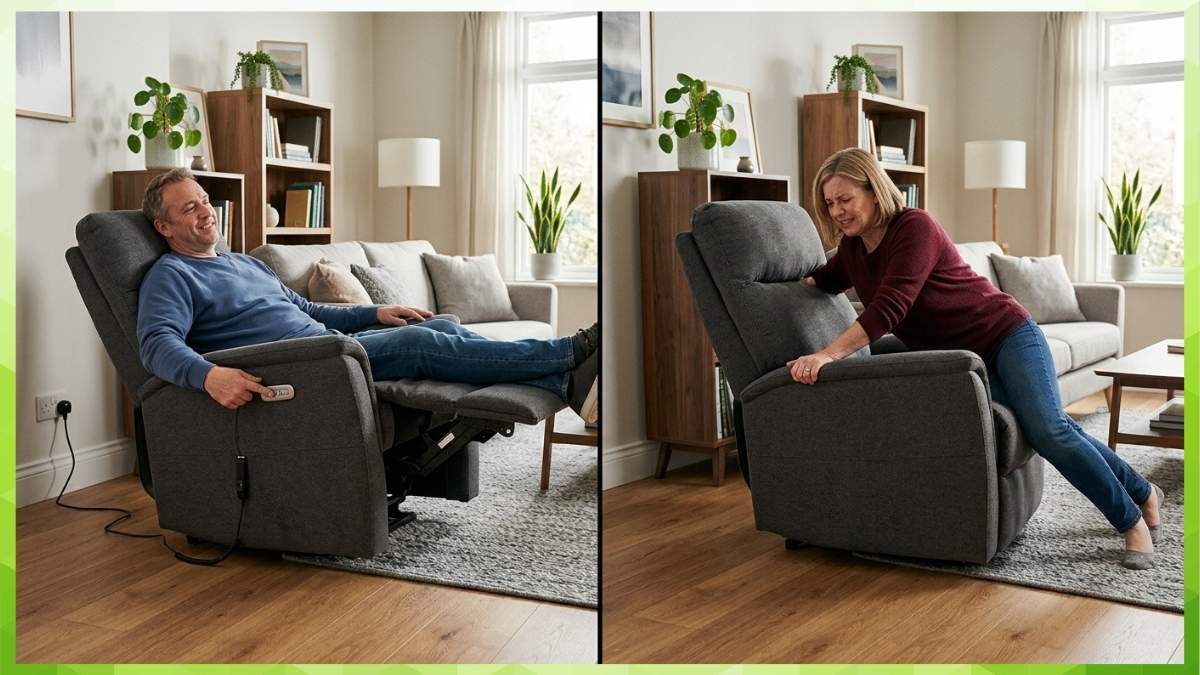
For most small spaces, a manual push-back recliner is the better default choice. It is lighter, requires no outlet proximity, has a slimmer profile without motor housing, and costs less. A power recliner wins when the user has limited mobility, wants precise partial positioning, or uses the chair for extended daily use where button-controlled micro-adjustment matters. The critical small-space consideration is not the mechanism itself but the chair’s wall clearance requirement and overall footprint. A compact manual push-back recliner at 27 to 28 inches wide sitting 4 inches from a wall beats a power recliner of any size that cannot physically fit the room. Measure first, then choose the mechanism.
How Each Mechanism Works in a Small Room?
A manual recliner reclines through physical input, either a side lever that releases the footrest and tilts the back, or a push-back mechanism where body weight initiates the motion. Manual recliners offer a set number of locking positions rather than infinite adjustment. The mechanism adds no bulk to the chair frame beyond the lever hardware, making manual recliners generally slimmer and lighter than power equivalents on the same frame. They require no outlet access and can be placed anywhere in the room regardless of where wall outlets are located.
A power recliner uses an electric motor hidden beneath the upholstery to move the seat, back, footrest, and in some models the headrest and lumbar independently at the press of a button. Most quality power recliners move from upright to fully reclined in 8 to 12 seconds and run at around 40 to 55 decibels, similar to a quiet conversation. The movement stops instantly when you release the button. The motor housing and wiring add bulk to the base of the chair, making power recliners generally heavier and wider at the base than manual equivalents. Most require placement within cord reach of a wall outlet, though rechargeable battery packs that mount under the chair are now widely available and eliminate the cord entirely.
In a small room, these differences have practical consequences. The outlet constraint of a corded power recliner can force a chair into a specific corner of the room rather than the optimal position. The extra base bulk of the motor housing can add 2 to 4 inches to the chair’s effective depth. The lighter weight of a manual recliner makes it easier to reposition during room rearrangements, which happens more frequently in multipurpose small spaces than in dedicated living rooms.
Manual vs Power Recliner Comparison
| Feature | Manual Recliner | Power Recliner |
|---|---|---|
| Mechanism | Lever, push-back, or pull-tab | Electric motor, button or remote |
| Recline speed | 3 to 5 seconds | 8 to 12 seconds |
| Position options | 3 to 5 preset positions | Near-infinite adjustment |
| Outlet required | No | Yes (or battery pack) |
| Noise during recline | Silent (mechanical click only) | 40 to 55 dB motor hum |
| Weight | Lighter | Heavier (motor adds bulk) |
| Profile/footprint | Slimmer base | Wider base due to motor housing |
| Best for small spaces | Yes, especially push-back | Yes, if outlet access is available |
| Best for mobility limitations | No | Yes |
| Long-term maintenance | Lower, fewer parts | Higher, motor may need service |
| Cord management needed | No | Yes (unless battery pack) |
Space Footprint: Does the Mechanism Change the Chair’s Size?
The mechanism type does affect the physical footprint of the chair, but less dramatically than most buyers assume. Manual recliners tend to look less bulky than power recliners since they do not need space for motors or electrical equipment. In practice, the motor housing in a power recliner adds width and depth to the base section of the chair. For compact models designed for small spaces, this difference typically amounts to 1 to 3 inches of additional base depth versus an equivalent manual frame.
The wall clearance requirement is the same regardless of mechanism. A wall hugger mechanism needs 3 to 6 inches whether it is manual or powered. A push-back mechanism needs 6 to 12 inches whether it is manual or powered. The mechanism that saves wall space is the wall hugger track design, not the choice between manual and power. Buyers who assume a power recliner automatically needs more wall clearance than a manual are applying the wrong variable. What changes with a power recliner is the outlet proximity requirement and the base bulk, not the wall clearance.
For the tightest small-space layouts under 12 feet of total room depth, either a compact manual push-back or a compact power wall hugger can work. The manual push-back wins on simplicity and cord-free placement. The power wall hugger wins on precise partial positioning and ease of use for all household members. If only one of the available compact models in your budget is a power version, the mechanism choice may be made for you by the product range rather than a deliberate preference.
Noise: A Small-Space Consideration Most Guides Skip
Noise is a more significant factor in small spaces than in large ones because the person using the recliner is typically closer to other people, sleeping areas, and shared walls. Power recliners have an internal electric mechanism that creates a faint but audible humming or whirring sound when adjusting positions. Manual recliners operate silently, with only the smooth glide of metal rails and springs during repositioning.
At 40 to 55 dB, a power recliner motor during operation is comparable to a quiet conversation or a low-level kitchen appliance. In most daytime use scenarios, this level of noise is not noticeable over ambient room sound. In a studio apartment where the recliner is adjacent to a sleeping area, in a bedroom recliner setup, or in a building with thin walls and close neighbors, the motor sound during late-night repositioning can be a genuine inconvenience. Manual recliners produce no motor noise at any time.
The noise consideration is most relevant for recliners used in bedrooms and studio apartments where the chair is within 10 feet of a bed. In a living room that is separated from sleeping areas, the 40 to 55 dB power recliner motor is unlikely to cause problems. If you are placing the recliner in a bedroom or a studio where sleeping happens nearby, a manual push-back or a push-back wall hugger is the quieter and simpler choice.
Outlet Access and Cord Management in Small Rooms
Outlet access is a practical constraint that affects power recliner placement more than any other single factor in small rooms. Most power recliners require a standard 120V outlet within reach of the cord, which is typically 4 to 6 feet long. In a small apartment where outlets are concentrated along one or two walls, this limits where the chair can be positioned without running an extension cord across the floor.
Extension cords across walkways are a tripping hazard and are not recommended for furniture with electrical components. The correct solution for power recliners placed away from an outlet is a rechargeable battery pack mounted under the chair. Most manufacturers now offer rechargeable battery packs that mount underneath the chair and eliminate the cord entirely. Battery packs typically provide 150 to 200 recline cycles per charge and recharge via a standard outlet when the chair is not in use. This eliminates the outlet proximity constraint entirely at a modest additional cost.
For renters in small apartments who cannot add outlets or run dedicated circuits, a manual recliner or a power recliner with a battery pack are both viable. A corded power recliner placed with the cord running across a walkway is not a safe long-term solution regardless of how well it fits the available space.
Which Is Better for Daily Use in a Small Space?
For small rooms or bedrooms, a compact push-back manual recliner is the most suitable choice. For users with mobility support needs, a power recliner or power lift recliner is best regardless of room size. This guidance reflects the practical reality that mechanism preference in small spaces is primarily driven by user needs rather than room size alone.
For a young, mobile household using the recliner primarily for TV watching, reading, and occasional napping, a well-chosen manual push-back recliner delivers every function needed at a lower cost, with quieter operation, simpler maintenance, and more flexible placement. The three to five preset positions are adequate for the vast majority of everyday use cases. Manual recliners with their simpler mechanics often boast greater long-term reliability and require less maintenance.
For a household with a senior member, someone recovering from surgery, or anyone with back pain, arthritis, or limited lower body strength, the power mechanism provides access to partial positions that genuinely improve daily comfort. Families living with parents or grandparents often find that power recliners make it easier for older adults to shift and stand independently. In these households, the power mechanism is not a luxury. It is a functional necessity that a manual recliner cannot replicate.
Pros and Cons Summary
Manual Recliner: Pros
- No outlet required, fully flexible room placement
- Silent operation, no motor noise at any time
- Lighter weight, easier to reposition during room rearrangements
- Slimmer base profile, less bulk in small rooms
- Lower long-term maintenance with fewer parts that can fail
- Less expensive on equivalent frames
Manual Recliner: Cons
- Limited to 3 to 5 preset locking positions
- Requires physical effort to recline and reset, problematic for mobility-limited users
- Lever is visible on the side of the chair, affecting aesthetics unless push-back design
Power Recliner: Pros
- Near-infinite position adjustment, stops at any angle on button release
- Smooth, slow motor movement ideal for users with mobility limitations
- Independent footrest and backrest control on many models
- Optional features including USB charging, heating, massage, and memory positions
- Battery packs available to eliminate outlet dependency
Power Recliner: Cons
- Requires outlet access or battery pack management
- Motor noise during operation at 40 to 55 dB
- Heavier and bulkier base due to motor housing
- Higher long-term maintenance if motor or wiring requires service
- More expensive on equivalent frames
Recommendations by Use Case
Best for a tight studio apartment with no dedicated living room: Manual push-back recliner in a compact width under 30 inches. No cord management needed and the push-back aesthetic avoids the lever that visually dates a recliner in a multifunctional space.
Best for a small bedroom recliner: Manual push-back or manual wall hugger. The silent operation matters more here than in a living room, and the absence of cord management simplifies the bedroom layout.
Best for a senior or mobility-limited user in a small apartment: Power wall hugger recliner with battery pack. The battery pack eliminates outlet constraints while the power mechanism provides the smooth, low-effort positioning that a manual recliner cannot match for this user group.
Best for a small home office that doubles as a reading nook: Manual push-back. Silent operation during video calls, no visible cord, and the push-back mechanism requires no lever that would interrupt the chair’s clean profile in a professional setting.
Best for a couple sharing a recliner in a small living room: Power recliner with independent seat positions or a power reclining loveseat where each seat operates independently. The ability to set different recline angles for different body types without a physical compromise makes power the better shared-use choice.
For specific compact recliner models in both manual and power configurations verified for small spaces, see the full guide: [Best Recliners for Small Spaces →]
Frequently Asked Questions
A manual push-back recliner is the better default. It requires no outlet, operates silently, has a slimmer base profile, and is lighter to reposition. A power recliner is the better choice when the user has mobility limitations or needs precise partial positioning for daily comfort.
Slightly. The motor housing adds 1 to 3 inches of base bulk compared to an equivalent manual frame. Wall clearance requirements are the same for both. The bigger space consideration for power recliners is outlet proximity and cord management rather than the chair’s stated dimensions.
Power recliners operate at approximately 40 to 55 dB during the recline motion, similar to a quiet conversation. In a living room with ambient sound this is not noticeable. In a bedroom or studio apartment where the chair is close to a sleeping area, the motor sound during late-night use is worth factoring into the decision.
Yes. Most major brands offer rechargeable battery packs that mount under the chair and provide 150 to 200 recline cycles per charge, eliminating the outlet proximity constraint entirely.
Generally yes for the mechanism. Manual recliners have fewer components, no motor or wiring, and require no electrical maintenance. Power recliner motors are rated for thousands of cycles and carry multi-year warranties, but they do introduce components that may eventually require service.
Last updated: May 2026 | Sources: Furniture Academy Manual vs Power Recliners (March 2026), Povison Power vs Manual Recliner Guide (January 2026), GARVEE Power vs Manual Recliner Guide (January 2026), Chita Living Power vs Manual Key Differences (January 2026), Alpine Outlets Manual vs Power Recliner Guide, Sofas and Sectionals Power vs Manual Pros and Cons.