Last Updated on May 17, 2026 by Kravelv Spiegel
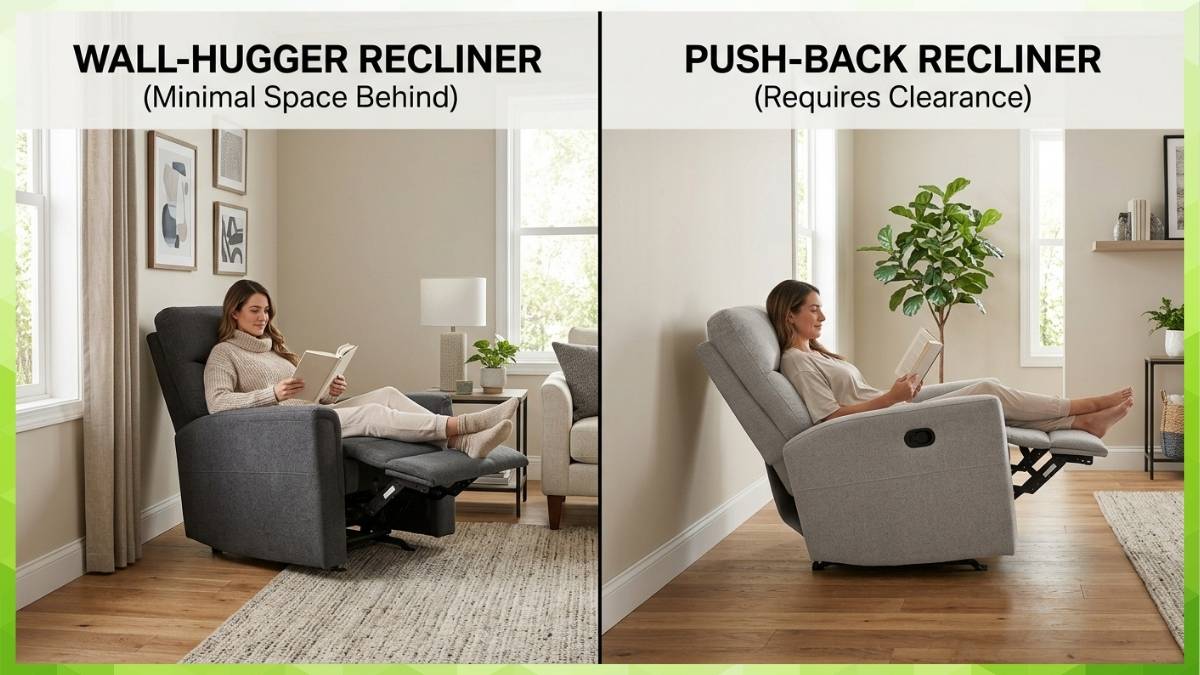
A wall hugger recliner and a push-back recliner both use a sliding track mechanism, but they serve different purposes. A wall hugger is specifically engineered to recline using a forward-slide track that keeps the back of the chair close to the wall, requiring only 3 to 6 inches of rear clearance instead of the 12 to 18 inches a standard recliner needs. A push-back recliner also slides on a track but is not designed to save wall space. It reclines when you lean back with your body weight, has no lever or handle, and looks like a standard armchair when upright. The key distinction: choose a wall hugger when wall clearance is the constraint. Choose a push-back when you want a cleaner, lever-free aesthetic without the space-saving engineering cost.
What Is a Wall Hugger Recliner?
A wall hugger recliner, also called a zero-wall or wall-saver recliner, uses a forward-glide track system mounted beneath the seat. When you recline, the seat base slides forward along internal rails while the backrest simultaneously tilts backward. Because the seat moves toward the room and the back stays near the wall, the chair needs only 3 to 6 inches of rear clearance to achieve a full recline angle of 150 to 170 degrees. Some advanced 2026 models operate with as little as 2 to 3 inches of clearance using precision-milled roller track systems.
The forward-slide mechanism is the defining feature of every wall hugger recliner and the only reason to choose it over other recliner types. In a 14-foot deep living room, the 12 to 15 inches of clearance saved by a wall hugger versus a standard recliner can be the difference between a functional layout and an unusable one. For apartments, condos, home offices, and multi-purpose rooms where furniture sits against a wall, the wall hugger mechanism opens layout possibilities that a standard recliner would close off entirely.
Wall hugger recliners are available in manual lever versions and power versions with motor-driven track systems. In power models, a single motor drives both the forward seat movement and the backrest tilt simultaneously, producing a smoother and more coordinated recline than a manual lever version. Manual wall huggers can sometimes feel slightly uncoordinated on the first recline because the user must initiate both movements through the lever.
What Is a Push-Back Recliner?
A push-back recliner shares the sliding track mechanism of a wall hugger but is not designed to save space behind the chair. Instead of a lever or handle, you recline by leaning back with your body weight. The backrest pivots on the track, the footrest lifts, and the chair settles into a reclined position. When you sit forward, the mechanism resets. There is no visible handle, button, or lever on the exterior of the chair.
The absence of a lever is the push-back recliner’s most important design feature from an aesthetic standpoint. Push-back recliners look like standard armchairs or accent chairs when upright. Most guests would not recognize one as a recliner until the footrest appears. This makes push-back recliners popular in living rooms and reading nooks where a conventional recliner’s lever and bulkier mechanism would clash with the room’s aesthetic. The Christopher Knight Home Mervynn, one of the most reviewed compact push-back recliners on Amazon, is a good example of a push-back design that reads as a mid-century accent chair when upright.
Because push-back recliners are not engineered for wall clearance, they require more rear space than wall huggers but less than traditional pivot-mechanism recliners. They typically need 6 to 12 inches of wall clearance depending on the model, sitting between the wall hugger and the standard recliner in their spatial footprint. Stressless recliners, one of the most recognized premium push-back brands, are a widely cited example of this recliner type.
Side-by-Side Comparison
| Feature | Wall Hugger Recliner | Push-Back Recliner |
|---|---|---|
| Recline mechanism | Forward-slide track, lever or power | Body-weight backward lean, no lever |
| Wall clearance required | 3 to 6 inches | 6 to 12 inches |
| Standard recliner clearance | 12 to 18 inches for comparison | 12 to 18 inches for comparison |
| Appearance when upright | Can look like accent chair depending on model | Always looks like a standard armchair |
| Lever or handle | Yes (manual) or power button | No lever or handle |
| Space-saving engineering | Yes, specifically designed for wall proximity | No, track used for recline smoothness only |
| Recline angle | 150 to 170 degrees | 120 to 150 degrees typical |
| Best for | Small apartments, rooms with wall behind seating | Living rooms, reading nooks, aesthetic-focused spaces |
| Available in power versions | Yes | Less common but available |
The Key Mechanical Difference
Both mechanisms use a track, but the purpose and direction of the track movement differ completely. In a wall hugger, the track is engineered to move the seat forward in proportion to how far back the backrest reclines. The two movements are mechanically linked so that the more the back tilts, the further forward the seat travels. This proportional linkage is what maintains the back of the chair close to the wall throughout the entire recline range.
In a push-back recliner, the track allows the seat and back to move together as a unit when body weight initiates the reclining motion. The track makes this movement smoother and more controlled than a simple pivot, but it does not compensate for the chair’s movement toward the wall. The back of a push-back recliner does move toward the wall when reclined, which is why it still requires more rear clearance than a wall hugger. A push-back recliner is not designed to save space behind the recliner, but rather to slide into a reclined position as efficiently and smoothly as possible.
The practical implication is that these two chair types cannot be substituted for each other in a tight-space layout. A push-back recliner installed in a position where only 4 inches of wall clearance is available will jam against the wall before reaching full recline. A wall hugger in the same position will fully recline without contact.
Comfort Comparison
Wall hugger recliners achieve full recline angles of 150 to 170 degrees. Push-back recliners typically reach 120 to 150 degrees. Standard traditional recliners with backward-pivot mechanisms often offer the deepest recline of the three types, and some people who use recliners primarily for extended napping or full-body lounging notice this difference.
Most users do not notice a meaningful comfort difference between a wall hugger and a push-back in everyday use. The forward-sliding motion of a wall hugger feels slightly different from the backward-leaning motion of a push-back, but both arrive at a reclined position that supports the back, neck, and legs adequately. Comfort differences between specific models are more attributable to seat cushion density, back cushion thickness, and footrest ergonomics than to the mechanism type.
The one scenario where mechanism type does affect comfort is for users who want to recline partially while maintaining an upright head position for reading or watching TV. Wall huggers in power versions allow precise partial positioning via the motor. Manual push-back recliners stop at whatever angle the user’s body weight naturally settles the mechanism, which is less adjustable.
Which One Is Right for Your Space?
Choose a wall hugger recliner if the chair will sit within 12 inches of a wall, if your room layout requires furniture to hug the perimeter to maintain walkway clearance, or if you are furnishing a dedicated home theater row where every inch of depth matters. The wall hugger’s engineering is the only practical solution for these scenarios. No other recliner type achieves a full recline with 3 to 6 inches of rear clearance.
Choose a push-back recliner if wall clearance is not your primary constraint and you want a recliner that looks like a standard armchair when upright. Push-back recliners are the better aesthetic choice for formal living rooms, reading nooks, and spaces where the visible lever of a traditional recliner would clash with the room’s design. Their lever-free exterior means they integrate naturally into furniture arrangements without announcing themselves as recliners.
If you are deciding between the two for a small apartment or studio where the chair will sit near a wall, the wall hugger is the correct choice. The push-back does not deliver enough wall clearance reduction to solve a tight-space problem the way a wall hugger does. For a complete list of wall hugger and push-back recliners verified available on Amazon in compact dimensions, see the full guide: [Best Recliners for Small Spaces →]
Frequently Asked Questions
No. Both use sliding track mechanisms, but a wall hugger is specifically engineered so the seat moves forward as the back reclines, keeping the chair close to the wall. A push-back uses a track for smooth motion but does not save rear clearance. A push-back still moves toward the wall when reclined.
Typically 6 to 12 inches depending on the model. This is less than a standard traditional recliner (12 to 18 inches) but significantly more than a wall hugger (3 to 6 inches). Always confirm the specific model’s requirement from the manufacturer’s spec sheet.
Not fully. A push-back needs 6 to 12 inches of rear clearance for the mechanism to operate correctly. Placing it directly against the wall prevents full recline and may strain the mechanism over time. For placement within inches of a wall, a wall hugger is the appropriate choice.
Yes for most users. Wall huggers reach 150 to 170 degrees of recline, comparable to or exceeding most push-back models. Comfort differences come from cushion quality and seat depth rather than mechanism type. Power wall hugger models offer more precise partial-position control than manual push-back models.
Push-back recliners require no lever or button, which some users prefer for simplicity. Wall huggers with manual levers require a deliberate pull to activate. Power wall huggers are the easiest of all, reaching any angle including partial recline with a single button press.
Last updated: May 2026 | Sources: Valencia Theater Seating Wall Hugger Guide (2026), Svago.com Wall Recliner Guide, BlvdHome Recliner Types, Furniture Fair Recliner Types, Coohom Wall Hugger vs Standard Recliners (March 2026), Keck Furniture Wall Hugger Guide (March 2026).