Last Updated on April 27, 2026 by Kravelv Spiegel
💡Key Takeaways:
Yes, but only if you use the right smart plug. A standard or budget smart plug is not safe for a space heater. A heavy-duty smart plug rated for 15A/1,800W with UL or ETL certification, a flame-retardant housing, and built-in overload protection is safe for most residential space heaters rated at 1,500W or below.
The distinction matters because space heaters are already one of the leading causes of home fires, adding an underpowered or uncertified smart plug to that equation introduces a real and preventable risk. Used correctly with a properly rated plug, smart control of a space heater is safe, legal, and genuinely useful.
Why space heaters are considered high-risk for smart plugs
Space heaters draw more continuous power than almost any other portable appliance in a typical home. Most residential space heaters run at 750W on low and 1,500W on high — the latter representing 12.5 amps of continuous current draw on a standard 120V circuit.
The problem with standard smart plugs is that most are rated for 10A or 1,200W — enough for lamps, phone chargers, and small fans, but not for a device running near the upper limit of a 15A circuit for hours at a time. When an undersized plug is asked to carry more current than it is rated for continuously, the internal relay and wiring heat up. Over time — or in a single extended session — this can cause the plug to overheat, melt, or fail. In worst-case scenarios, it can start a fire.
Appliance expert Tatyana Dimitrova of Fantastic Services advises: “High-wattage appliances such as space heaters, air conditioners, kettles and irons, shouldn’t be plugged into a standard smart plug because smart plugs typically have a maximum load rating, often around 10 to 15 amps. High-wattage devices can easily exceed this, which could cause the plug to overheat, fail, or even become a fire hazard.”
This warning applies specifically to standard and budget smart plugs — not to heavy-duty 15A-rated plugs with proper safety certifications.
What makes a smart plug safe for a space heater
Not all 15A smart plugs are equally safe for continuous high-load use. Here are the specific features that separate a safe plug from a risky one when used with a space heater.
UL or ETL certification is the non-negotiable baseline. Both UL and ETL are OSHA-recognized Nationally Recognized Testing Laboratories (NRTLs) that test products against the same safety standards. A plug with either certification has been independently tested for electrical safety at its rated amperage. A plug without either certification has not — regardless of what the manufacturer claims on the packaging.
Flame-retardant housing rated V-0 under the UL 94 standard means the plug’s outer shell will self-extinguish if it ignites rather than contributing to a fire. This is a critical feature for a device that may run at elevated temperatures for extended periods.
15A continuous load rating — confirmed in the manufacturer’s specification sheet, not just the product title. Some plugs marketed as “15A” are rated for 15A peak but derated for continuous use. Confirm that the plug’s listed maximum load applies to sustained operation, not momentary draw.
Built-in overload protection automatically cuts power to the connected device if current exceeds a safe threshold. This feature varies by model — check the specification sheet rather than assuming it is included.
The 80% Rule: Why a 1,500W Heater on a 15A Plug Needs Attention
Electricians and the National Electrical Code (NEC) apply what is commonly called the 80% rule for continuous loads: a circuit or device should not carry more than 80% of its rated capacity on a sustained basis. For a 15A circuit, 80% equals 12A, which corresponds to 1,440W at 120V.
A space heater rated at 1,500W draws 12.5A — technically above the 80% continuous load threshold for a 15A circuit. According to NEC 210.23(A)(1), a 1,500W heater on a 15A circuit exceeds the maximum 1,440W allowable rating at 80% of the circuit’s capacity.
In practical terms for smart plug users, this means:
- A 750W space heater on a 15A smart plug is comfortably within safe limits at any duration
- A 1,000W–1,200W space heater on a 15A smart plug is safe for normal use
- A 1,500W space heater on a 15A smart plug is within the plug’s rated maximum but above the NEC 80% continuous load guideline — safe for cycling use (thermostat-controlled heaters that turn on and off) but worth monitoring for extended full-power sessions
If your space heater runs at 1,500W continuously for hours — as a fixed-output non-thermostat model does — a 20A-rated smart circuit switch is the more conservative choice. For thermostat-controlled heaters that cycle on and off, a properly rated 15A plug is safe.
What Amazon’s own safety guidelines say
Amazon’s official safety guidelines for its Smart Plug state: “Do not use your Amazon Smart Plug to operate equipment where continuous or unsupervised operation could be dangerous (e.g., stoves, or heaters).”
This warning is specific to Amazon’s own plug — which is not rated or marketed as a heavy-duty device. It does not mean all smart plugs are unsafe for heaters. It means Amazon’s standard plug is not the right tool for the job. Heavy-duty plugs explicitly marketed and rated for space heaters — with 15A certification, flame-retardant housings, and overload protection — are a different category from the generic Amazon Smart Plug.
The key takeaway: always check the manufacturer’s own safety documentation for your specific plug, not just the amperage rating on the packaging.
Which smart plugs are safe for space heaters
The following plugs from our main guide are rated and certified for space heater use:
Kasa KP115 — 15A/1,800W, UL certified, V-0 flame-retardant housing. The most widely tested and recommended plug for space heaters across independent review sources. Suitable for heaters rated up to 1,500W in thermostat-cycling use.
Govee Smart Plug with Energy Monitoring — 15A/1,800W, ETL and FCC certified, fire-resistant construction. Govee explicitly lists space heaters as a supported appliance type.
Kasa EP25 — 15A/1,800W, UL certified, supports Apple HomeKit, Alexa, Google Home, and SmartThings. Same safety specification as the KP115 with broader platform compatibility.
BN-LINK WiFi Heavy Duty Smart Plug — 15A/1,875W, ETL and FCC certified, marketed specifically for heavy-duty appliances including space heaters.
For a full comparison of these plugs including energy monitoring features, app quality, and pricing, see our complete guide: [Best Smart Plugs for Heavy Appliances →]
Unsafe combinations: What to avoid
Standard or budget smart plugs (10A/1,200W or unrated). Any plug not explicitly rated at 15A/1,800W should not be used with a space heater. This includes many white-label plugs sold in multipacks for low prices on Amazon without visible certification marks.
Power strips or extension cords. Space heaters draw 1,000–1,500 watts — up to 12 amps — which can overload power strips rated for intermittent loads, causing overheating and fire risk. A smart plug must be inserted directly into a wall outlet, not into a power strip or extension cord.
Daisy-chained plugs. Plugging one smart plug into another is explicitly prohibited by most manufacturers and creates a compounded overload risk.
Uncertified plugs from unknown brands. According to UL safety guidelines, uncertified plugs from unknown brands carry documented fire risks — this is not a category to buy on price alone.
Medical devices on any smart plug. Power interruptions from Wi-Fi drops, scheduled automations, or manual errors can be dangerous for life-supporting equipment. Never place CPAP machines, oxygen concentrators, or similar devices on a smart plug.
Smart plug features that improve heater safety
Beyond choosing the right rated plug, these features specifically reduce risk when using a smart plug with a space heater:
Scheduling and auto-off timers are arguably the highest safety benefit of using a smart plug with a heater. The most common cause of space heater fires is an unattended or forgotten heater. Scheduling the plug to cut power after a set time — or automatically at bedtime — eliminates that risk entirely.
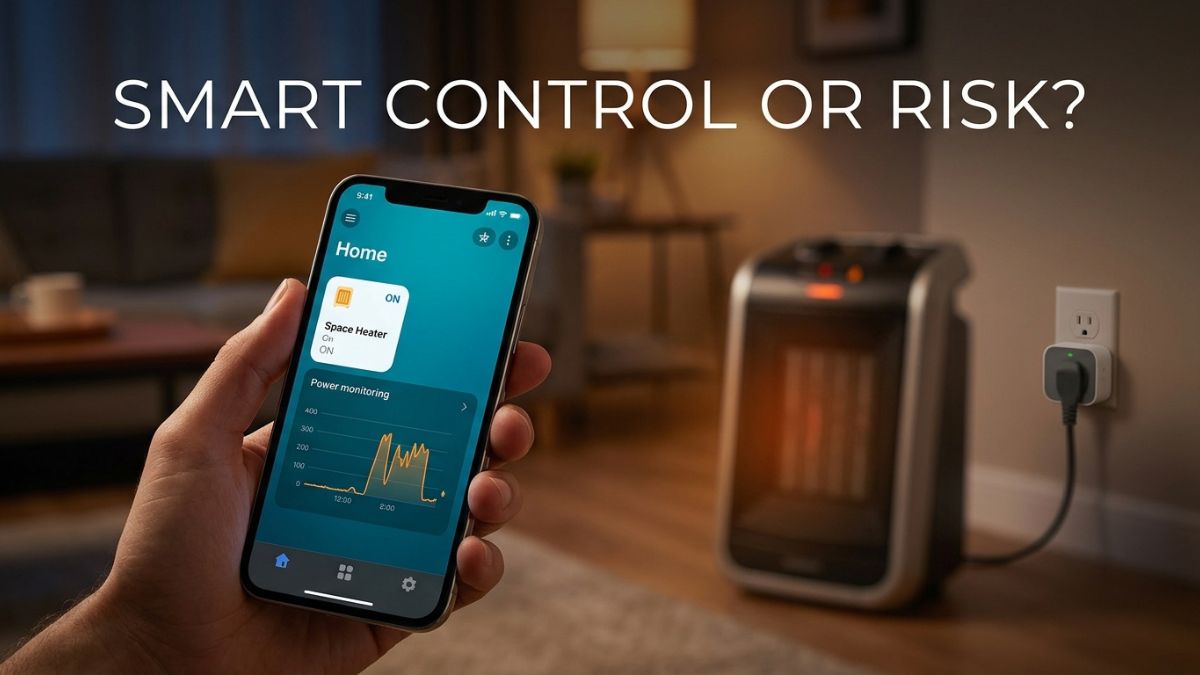
Energy monitoring lets you verify the heater is drawing expected wattage. An unusual spike or sustained draw above the heater’s rated wattage can indicate a fault in the heater itself — caught before it becomes a hazard.
Away mode and remote shutoff let you turn off a heater you left on from anywhere via your smartphone — one of the most practical safety features a smart plug adds to any heating appliance.
Voice control reduces the need to physically approach a running heater to adjust it, which is a minor but real reduction in interaction risk in tight spaces.
Frequently asked questions
Only with a properly rated plug (15A/1,800W, UL or ETL certified) and only with an auto-shutoff schedule set. Leaving any space heater running unattended overnight is a fire risk regardless of the smart plug — use the scheduling feature to cut power after a set time. Never leave a 1,500W heater running at full power continuously for extended unsupervised periods.
The maximum rated wattage for a 15A/1,800W plug is 1,800W. However, the NEC 80% continuous load guideline recommends keeping sustained loads under 1,440W on a 15A circuit. For practical purposes: heaters rated at 1,500W are within the plug’s maximum rating and safe for thermostat-cycling use. For heaters running at full 1,500W continuously for hours, a 20A circuit solution is more conservative.
Most space heater manufacturers do not explicitly address smart plug use in their warranty terms. However, using a properly rated, certified plug that delivers clean, stable power is unlikely to affect warranty claims. What would void a warranty — and create liability — is using an underpowered or uncertified plug that damages the heater through power instability.
An improperly rated or uncertified smart plug used with a high-draw heater can overheat and fail, which can cause a fire. A properly rated 15A smart plug with UL or ETL certification and a flame-retardant housing used within its rated capacity does not introduce meaningful fire risk beyond what the heater itself already presents.
In most real-world scenarios, yes — because the scheduling and remote shutoff features eliminate the most common space heater danger: unattended or forgotten operation. The plug adds a controllable kill switch to an appliance that otherwise has no remote off capability.
Final words
Smart plugs are safe for space heaters when the right plug is used. The requirements are straightforward: 15A/1,800W minimum rating, UL or ETL certification, flame-retardant housing, and direct insertion into a wall outlet. Standard or budget plugs without these specifications are not safe for sustained high-draw use. Used correctly, a heavy-duty smart plug adds meaningful safety benefits to space heater operation through scheduled shutoffs, remote control, and energy monitoring.
For recommendations on specific heavy-duty smart plugs rated and certified for space heater use, see our complete guide: [Best Smart Plugs for Heavy Appliances →]
Sources: U.S. Consumer Product Safety Commission, National Electrical Code 210.23(A)(1), Amazon Smart Plug Safety Guidelines, Tom’s Guide, UL Standards.